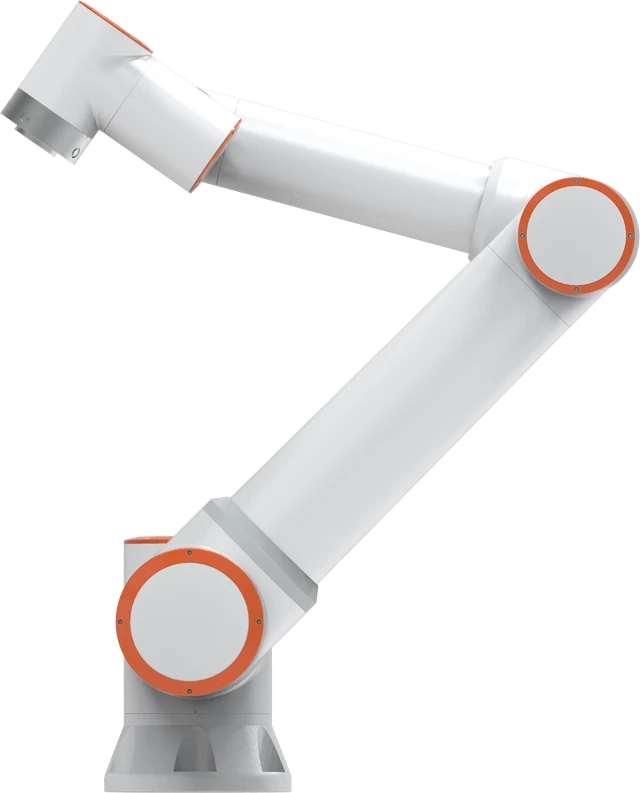
One configuration to evaluate for the requirements discussed here. Check tooling load, the complete motion path and process requirements before selecting the arm.
View FR30 specifications and quote considerationsThree kinds of equipment can stack cases at the end of a line: a collaborative robot (cobot) palletizer, a conventional industrial robot cell, and a conventional layer-forming palletizer. Case weight and line rate settle most of the choice. FAIRINO belongs in the first group, with the FR20 and FR30 as model examples for the cobot column below.
The three options side by side
| Factor | Cobot palletizer | Industrial robot cell | Conventional layer palletizer |
|---|---|---|---|
| Case plus gripper weight | Bounded by arm payload | Wide range, including heavy and multi-case picks | Product is conveyed, not lifted by a wrist |
| Rate | Low; one case or small group per cycle | Medium to high | Highest |
| Stack height | Limited by reach; a lifting column extends it | Long-reach arms from a fixed base | Built into the machine |
| Footprint and guarding | Compact; measures set by risk assessment | Larger guarded cell | Largest, with conveyors and fixed guarding |
| Changeover | Recipe and gripper settings | Recipe, sometimes a tool change | Pattern recipe; strongest on stable formats |
The rows are generalisations; the sections below qualify them.
Case weight: add the gripper before choosing a class
A robot lifts the case and the tool. FANUC's palletizing robots page tells buyers to weigh the combined weight of product, end-of-arm tool and dress-out, and describes industrial palletizing robots with payloads up to 800 kg.
Against that, the FAIRINO catalog values are 20 kg and 1,854 mm reach for the FR20, and 30 kg and 1,403 mm for the FR30. Confirm the applicable load limits for the delivered configuration.
An illustrative check: a hypothetical 18 kg case with an assumed 4 kg vacuum gripper and bracket is 22 kg at the wrist. That is over the FR20's catalog payload; the FR30 merits a load and reach review, but its payload alone does not validate the cell. A 25 kg sack on a 6 kg tool is 31 kg, exceeding both models’ catalog payloads. That case requires a different equipment review, including industrial robots or conventional machines.
If the line stays manual for now, the Revised NIOSH Lifting Equation is the usual tool for judging the lifting task; it describes the job you are replacing, not the robot.
Rate: be candid about where a cobot stops
We do not quote a cases-per-minute figure for FAIRINO cells, because rate depends on the pattern, travel distance, grip time and the speed the risk assessment allows. Other makers' published figures show the scale, each within its own scope:
- Universal Robots' palletizing deployment guide estimates about 6 boxes per minute for its worked example, a UR10e stacking 8 kg boxes at default speeds the guide calls generally safe for collaborative operation. It adds that shorter cycles may need additional measures.
- FANUC states that an industrial palletizing robot can handle up to 30 cases per minute, depending on robot type and application.
- Columbia Machine's floor-level palletizer range includes a model listed at up to 100 cases per minute. These machines form rows into layers and stack whole layers.
None of these is a promise for your line, and none describes FAIRINO. They do show the pattern: a single-pick cobot suits a slow to moderate line, an industrial robot covers the middle, and layer machines suit high-speed, high-volume lines. A multi-pick gripper raises cobot output but also the carried load. The case palletizing cell design guide shows how to balance line output against pallet exchange.
Stack height, reach and what a lifting column changes
A fixed-base arm has to reach the far corner of the bottom layer and the far corner of the top layer. The UR guide notes that when the calculated maximum pallet height falls short of the process, a seventh axis is required to expand the workspace.
A lifting column, the usual seventh axis, raises the robot base as the stack grows. It changes vertical coverage without adding payload or horizontal reach, and it brings its own cost, travel time and moving structure to assess. The FR20’s 1,854 mm nominal reach and the FR30’s 1,403 mm nominal reach are starting points for checking pallet coverage. Compare the two on the payload and reach comparison, then check the real pattern at full height.
Footprint and guarding approach
FANUC's page notes that cobots suit tight spaces and applications where collaborative operation is wanted. The space saving depends on the guarding outcome. A collaborative arm does not make the cell safe by itself: the UR guide requires a full risk assessment, discusses force and speed limits, and describes running at higher speed when the area is clear and dropping to a reduced mode when an operator enters. If your rate needs fencing or scanners, compare that footprint with an industrial cell. Our cobot risk assessment guide sets out what that assessment covers.
Industrial robot cells and layer palletizers are designed as guarded machines; Columbia describes a Category 3 safety system on its floor-level range. Measure conveyor runs, maintenance access and the forklift approach as well as the machine.
Changeover and budget scope
All three run from stored recipes. A cobot or industrial robot changes pattern in software; who can edit recipes is covered in the palletizing programming guide. Layer machines are strongest when formats repeat. Mixed loads are a separate problem, addressed in the mixed-SKU palletizing guide.
Scope varies too much for a useful price here. Compare quotes line by line:
- Arm or machine, controller and palletizing software
- Gripper, vacuum generation and any lifting column
- Infeed conveyor, case stop, pallet locators and slip-sheet handling
- Guarding, scanners and the documented risk assessment
- Installation, pattern setup, training and acceptance testing
Which one fits your line
Shortlist a cobot palletizer when the case and gripper fit the selected model’s complete load limits, the line is slow enough for single or small multi-picks, floor space is tight and formats change often. Look at an industrial robot when cases are heavy, the rate needs row picks, or one robot must serve several lines. Choose a layer palletizer when one high-speed line runs stable formats all day.
Send case weight and dimensions, line rate, pattern and finished height to compare suitable equipment, including whether the FR20 or FR30 examples merit a trial. Request a consultation or start from the palletizing overview.
Sources and further reading
Plan your next automation project
Share your parts, process, and production goals. Get help comparing robot options, planning the complete application, and deciding what to do next.
Request a consultation