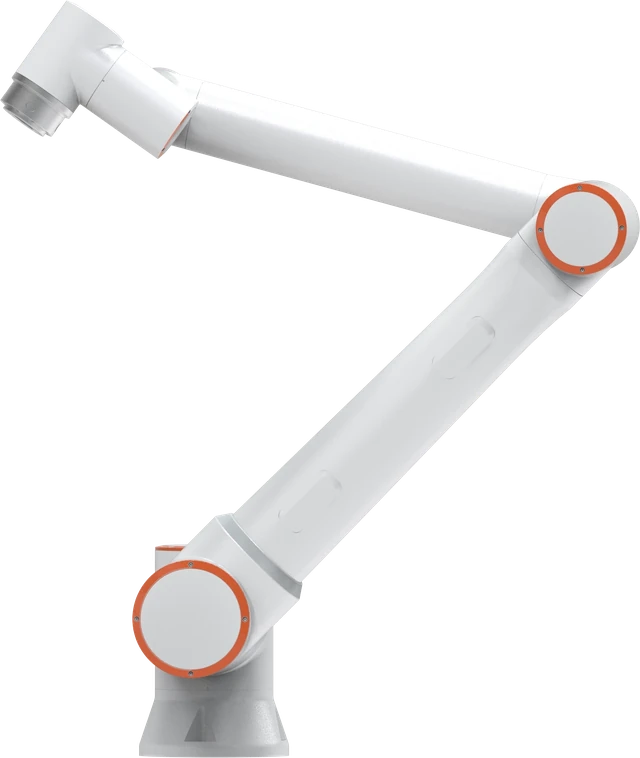
One configuration to evaluate for the requirements discussed here. Check tooling load, the complete motion path and process requirements before selecting the arm.
View FR10 specifications and quote considerationsMost cobot demos prove that a robot can move. The purchase question is narrower: can this arm, with this tool, run your part at your rate and recover when something goes wrong? When evaluating a cobot, decide before the demo which result would justify an order, which would rule the configuration out, and which would call for a second trial. The same measures then become your acceptance terms.
Write the purchase question in one sentence
A hypothetical example: "Can a FAIRINO FR10 with a two-finger gripper load and unload our housing family at the lathe, at the cycle we need, with one operator covering two machines?" That sentence names the arm, tool, part, station, rate and staffing. Each becomes something to measure.
Use the catalog figures to pick the candidate, then let the trial test it. The FR10 is listed at 10 kg payload and 1,400 mm reach. Payload includes the gripper, fingers and adapters, so a part near the rated figure needs the next size up or a lighter tool. If the question is still loose, the first cobot project guide and the project planner help you pin down the task first.
Bring the person who runs the job today. A NIST Manufacturing Extension Partnership article on making a first robot integration succeed advises engaging the people who operate the current process and starting with a simple application.
What to send before the demo
A demo is only as representative as the material it runs.
- Parts: typical samples plus the worst legitimate cases, meaning the heaviest, longest, thinnest, oiliest and the one at the edge of tolerance that production still accepts.
- Drawings: dimensions, tolerances, datums, mass and any surface that must not be marked.
- Cycle target: the rate you need, how you measured the current rate, and whether loading, inspection and replenishment are included.
- Station photos and video: the machine or bench, door opening, fixtures, floor space, obstructions and one complete manual cycle.
- Presentation: how parts arrive and leave (tray, bin, conveyor, pallet) and how consistent their position is.
- Interfaces and utilities: machine signals available, air supply, power and network.
- Quality check: how a good part is judged today and who judges it.
- People: who approaches the station during operation and how often.
Mark estimates as estimates. Send the same package to every supplier, as the vendor selection guide recommends, so results are comparable.
Four things to watch that a short video hides
The full cycle
Time from one finished part to the next over many consecutive cycles, including waiting for the machine, regripping and placing the finished part. A single fast pick shows top speed and little else.
The real tool load
Ask for the proposed gripper or torch package, or a stand-in of equal mass and offset, with the payload and center of gravity entered in the controller.
Recovery from a fault
Have someone remove a part mid-cycle, present one misplaced, or press the stop. Watch how the cell reaches a known state and who can restart it. Note whether it needs a programmer.
Changeover
Ask to see the second part number set up from scratch or recalled from a saved program.
Also ask which safety settings were active. Speeds used in a guarded demo area may differ from those your application allows; the risk assessment guide explains why. Keep datasheet terms in their place too: ISO 9283 is the ISO standard for performance criteria and related test methods for manipulating industrial robots, so figures of that kind describe the arm. Whether your process holds tolerance depends on the tool, fixture and part as well, a distinction covered in repeatability versus accuracy.
Record results so they can be repeated
Treat the demo as a test with a log. For each run, write down the arm model and software version, tool and payload settings, programmed speed, part identifiers, number of cycles, each stop with its cause, and the time taken to recover. Video the whole run from a fixed position and ask for the program and settings used.
A result belongs to the configuration that produced it. If the gripper, fixture or part presentation changes afterward, note which measurements need repeating.
Turn the results into FAT and SAT criteria
Acceptance usually happens twice. IEC 62381:2024, written for process-industry automation systems, defines factory and site acceptance tests as the means of demonstrating that a system meets its specification, with owner, buyer and vendor agreeing scope and responsibilities. The same split suits a robot cell. For the site stage, the OSHA Technical Manual chapter on robot systems describes site acceptance testing as confirming that equipment performs as expected with the site's utilities, performed by the integrator, verified by the user and completed before first startup.
Each line needs a method and a number. The thresholds below are illustrative placeholders for the hypothetical lathe example, not recommended values; set yours from the demo data and the business case.
| Criterion | How it is measured | Illustrative pass condition | Stage |
|---|---|---|---|
| Sustained cycle | Timed continuous run including replenishment | Average of 45 s or less over 200 consecutive cycles | FAT and SAT |
| Good parts | Your existing inspection method | 200 of 200 within drawing tolerance, no handling marks | FAT and SAT |
| Part variants | Each worst-case sample from the list | All 5 variants run 20 cycles each without re-teaching | FAT |
| Unassisted running | Logged operator interventions | No more than 1 intervention per 100 cycles | SAT |
| Fault recovery | Induced missing part, misplaced part, stop and power cycle | Trained operator restores production within 3 minutes using the written procedure | FAT and SAT |
| Changeover | Performed by your operator, timed | Second part number running within 15 minutes, first part good | SAT |
| Safety validation | Checks defined by the risk assessment | Every safety function verified in the final configuration; records delivered | SAT |
| Handover | Document review and restore test | Backup restored successfully; operators and maintenance trained | SAT |
State who supplies parts for each test, how long the run lasts, and what happens after a failed line: correction, retest, and the effect on payment milestones. Cells with cameras need extra lines for lighting and calibration, set out in the machine vision integration plan.
Bring the package to a demo request
Use the form to request a demo or consultation, and describe the application using the package above. The form takes text only and records the request; drawings, photos and video can follow once contact is made. Follow-up then coordinates what kind of demonstration or sample-part review is practical and what it can and cannot establish. If FAIRINO models are among your candidates, the model comparison helps screen payload and reach before the trial.
Sources and further reading
- NIST Manufacturing Innovation Blog: How to Make Your First Robot Integration a Success
- ISO: ISO 9283:1998 Manipulating industrial robots, performance criteria and related test methods
- IEC Webstore: IEC 62381:2024 Factory acceptance test (FAT), site acceptance test (SAT) and site integration test (SIT)
- OSHA Technical Manual: Industrial Robot Systems and Industrial Robot System Safety
Plan your next automation project
Share your parts, process, and production goals. Get help comparing robot options, planning the complete application, and deciding what to do next.
Request a consultation