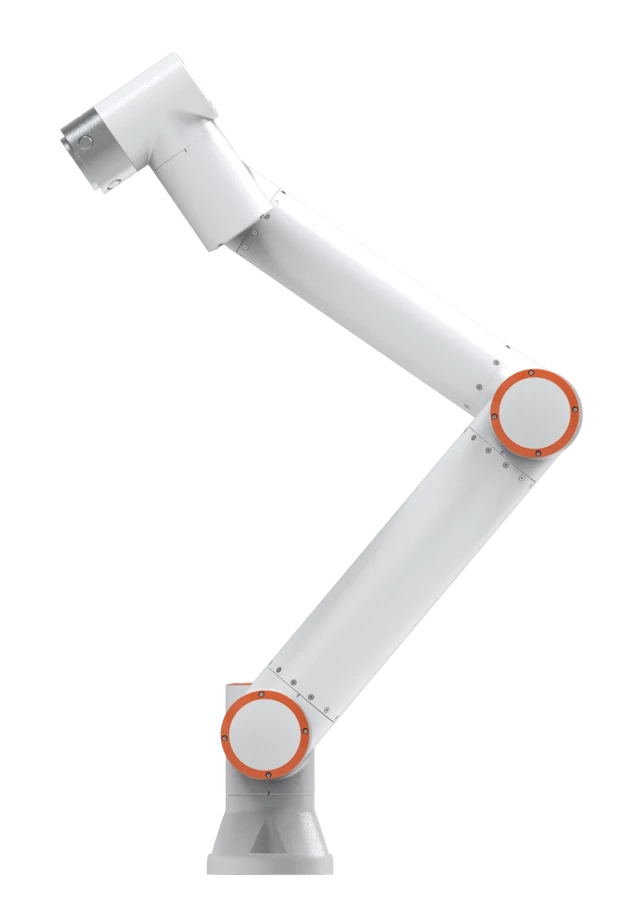
One configuration to evaluate for the requirements discussed here. Check tooling load, the complete motion path and process requirements before selecting the arm.
View FR3-WML specifications and quote considerationsA welder closes a 2 mm gap without thinking about it. A robot welds the path it was taught, and the gap becomes a defect. That difference decides which weldments suit cobot welding, so screen the part family before choosing the cell. The screen below needs a drawing, a few production parts and a gap gauge, and its reach row uses catalog figures for the three FAIRINO welding configurations.
Score the part family on six criteria
Give each row 2, 1 or 0 points, scoring what your shop produces today.
| Criterion | 2 points | 1 point | 0 points |
|---|---|---|---|
| Repeat volume | Family returns weekly or monthly | Returns a few times a year | One-off or rarely repeated |
| Fit-up and gap | Gaps consistent part to part | Variation controllable with better tacking or clamping | Welder fills varying gaps by eye |
| Torch access | Open fillets and laps, straight or simple curved seams | Some inside corners need a changed torch angle | Seams inside boxes, behind gussets or in deep channels |
| Weld position | All seams flat or horizontal in one clamping | One re-clamp or a simple positioner puts seams in position | Many orientations, overhead or all-around pipe seams |
| Size against reach | All seams inside the envelope with torch-angle margin | Reachable with one repositioning | Weldment larger than the envelope |
| Fixturing | Locates from repeatable features; simple clamps | Needs a dedicated fixture but geometry allows it | No stable datum; part distorts or must be pulled into shape |
10 to 12 points: a strong candidate; take it to a sample-part trial. 6 to 9: conditional; fix the low rows before buying, usually upstream tolerance or fixturing. 5 or fewer, or any zero on fit-up or access: leave it with manual welders for now or look at a different kind of cell. These thresholds are our suggested sorting aid, not a validated standard, and a trial outranks the score.
Volume and batch size: repeat frequency matters more than run length
Miller's automation planning guidance describes simple, repeatable parts with high volume and low sophistication as the natural fit for welding automation, with cobots as a first step for simple parts. Each new part still costs a fixture, a program and a proving run, so a small batch that returns monthly can repay effort that a one-time large batch does not.
Writing in the American Welding Society's Welding Digest, Doug Scheetz of Flextur advises automating the simplest, most consistent parts first and building on that success.
Fit-up and gap consistency
The same AWS article warns that a cobot cell exposes the irregular parts manual welders have been compensating for, and sums it up as "if you can't repeat it, you can't automate it."
Measure it. Pull assemblies from several batches, tack them as usual and record the gap at the start, middle and end of each seam. If the spread is wide, fix cutting and bending before buying a weld cell. Sensing can absorb some variation, but Miller notes that adapting to poor fit-up may require more expensive options and complicates the process.
Torch access, joint type and position
The torch arrives with a wrist, mount and hose behind it, and all need clearance. Fillets and laps on open geometry are the easy cases; open-root butts, seams inside enclosures and short welds separated by many re-orientations are the hard ones.
Position matters as much as access. If the part must be turned to bring seams into flat or horizontal positions, count the turns: one manual re-clamp is workable, while continuous rotation calls for a positioner coordinated with the arm. Process changes the score too, since TIG demands closer fit-up than MIG; see MIG versus TIG for a cobot cell.
Part size against reach
The AWS article notes that arm and table size directly influence which system fits. Catalog figures for the FAIRINO welding configurations set the starting point:
- FAIRINO FR3-WMS: 3 kg payload, 622 mm reach. Small parts fixtured close to the base.
- FAIRINO FR3-WML: 3 kg payload, 922 mm reach. Benchtop weldments.
- FAIRINO FR5-WML: 5 kg payload, 1,900 mm reach. Longer seams, larger frames or two fixture stations.
Usable welding reach is shorter than the catalog number, because the torch must arrive at the correct angle and the hose must follow, and payload includes the torch and everything mounted with it. Sketch the fixture and the farthest seam, then follow the payload and reach checks. When a weldment exceeds the envelope, weld it in two clampings or accept that it belongs in a larger cell.
Fixturing and tacking
Bernard and Tregaskiss, a robotic welding gun manufacturer, calls fixturing critical to part repeatability and warns that parts within specification can still be welded incorrectly if they are not held in an exact position.
Decide where tacking happens. Presenting a tacked assembly keeps the weld fixture simple; loading loose pieces saves a step but demands more clamps and torch clearance. Fixtures are a budget line of their own, covered in the welding cobot budget guide.
Work that belongs with welders or an industrial robot cell
Keep with manual welders: repair and one-off work, variable-gap structural fit-up, seams reachable only by hand, and assemblies that must be pulled into shape during welding.
Consider a conventional industrial robot cell when volume is high and stable, when the part needs coordinated positioner axes or a heavier torch package, or when cycle time justifies a fully guarded high-speed cell. The industrial robot versus cobot comparison covers that decision. A cobot welding configuration may suit the middle ground: recurring small and medium weldments with open joints and controlled fit-up. Compare its complete process package and demonstrated weld quality with the alternatives.
Arc and fume hazards stay with the part
Suitability includes the material. NIOSH states that most welding fumes contain manganese and that confined-space welding can significantly increase exposure, so the base metal, filler and coatings determine the extraction the cell needs. The AWS article adds that welding light flashes remain damaging and that safety curtains are too often missing around cobots. A collaborative arm changes neither hazard, so include screens, extraction and hot-part handling in the cell risk assessment.
Next step: a sample-part trial
Send ordinary production samples of the highest-scoring part family with the drawing, weld requirements and your gap measurements. Ask for the trial to record the fixture concept, torch package, parameters, reach margin and how many parts needed no touch-up. Agree pass criteria beforehand using the demo and acceptance test guide, and carry the results into the welding quote checklist. To review your screening scores and suitable welding configurations, request a demo or consultation; follow-up confirms what can be arranged.
Sources and further reading
Plan your next automation project
Share your parts, process, and production goals. Get help comparing robot options, planning the complete application, and deciding what to do next.
Request a consultation