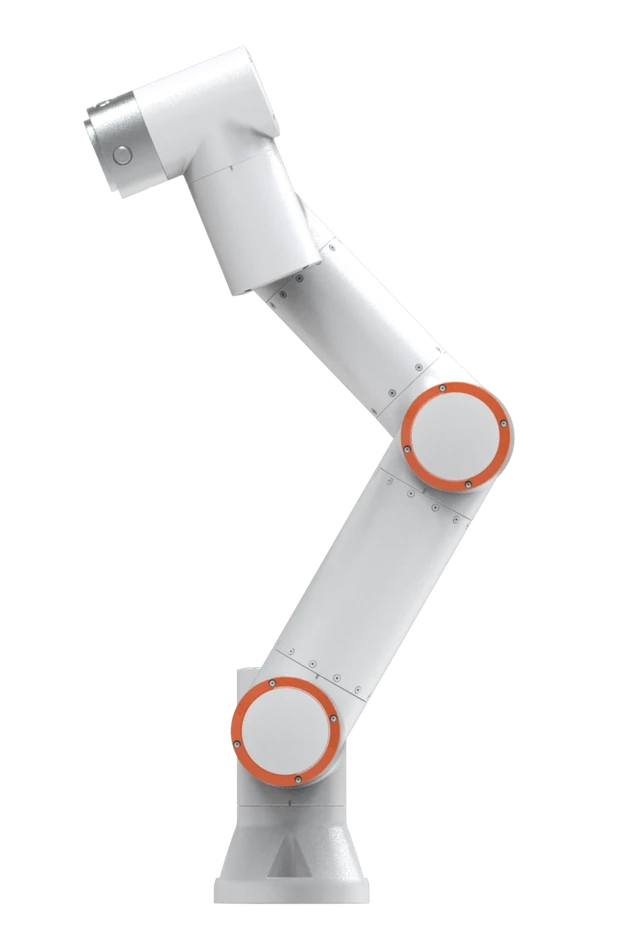
One configuration to evaluate for the requirements discussed here. Check tooling load, the complete motion path and process requirements before selecting the arm.
View FR3-WMS specifications and quote considerationsFor most first cells, the answer is MIG. Gas metal arc welding (GMAW, commonly called MIG) feeds its own filler, tolerates more variation and travels faster, so the arm needs less supporting equipment. TIG (gas tungsten arc welding, GTAW) belongs in a first cell only when the part demands it: thin stainless or aluminum, visible seams, or a procedure that specifies the process. The choice sets the torch package the arm must carry, and the three FAIRINO welding configurations are rated at 3 kg or 5 kg including everything mounted on the wrist.
Why MIG is the usual first process for automatic welding
In MIG the wire is both electrode and filler. The robot has one thing to position: the wire tip relative to the joint. TWI's description of the MIG/MAG process notes that the wire is fed continuously, the power source normally delivers a constant voltage, and wire feed rate and arc length are controlled by the power source. In manual work the welder supplies travel speed and wire position, the two variables a six-axis arm repeats well.
That division of labor is why automatic welding with a cobot usually starts here: filler delivery is already mechanized and production travel speeds are higher than TIG.
MIG still punishes poor preparation. Miller's welding automation guidance says part preparation and fit-up need to be consistent for a robot to produce quality welds each time. Check your parts against the cobot weldment suitability screen first.
What TIG automation adds to the project
TIG separates the jobs MIG combines. The tungsten electrode does not melt, and TWI's TIG process summary states that when filler is required it must be added separately to the weld pool. An automated cell therefore needs four things a MIG cell does not.
- Arc length held by the robot path. TIG uses a constant-current power source, so the arc does not correct itself through wire burn-off. Torch height along the seam depends on fixture repeatability, a correctly taught tool center point and electrode condition.
- A cold-wire feeder aimed at the pool. Unless the joint is fused without filler, wire must enter the pool at a fixed position and angle. Fronius, for example, lists cold-wire feed units for its robotic TIG torches with mechanical locking for a constant wire position, plus water-cooled torch bodies and a collision box.
- Tighter joint preparation. For mechanized TIG, TWI advises machined edge preparation and close control of fit-up and parameters.
- Arc starting that suits electronics. High-frequency starting is the most common TIG ignition method, and TWI warns that it causes electromagnetic interference with nearby electronic equipment. Ask how the proposed power source starts the arc and how the robot controller and sensors are protected.
TIG also travels and deposits more slowly, so its payback case rests on finish quality, reduced rework or scarce TIG labor more than on output. The Fronius hardware is an example of what a robotic TIG package contains; that page does not address FAIRINO controllers.
MIG and TIG compared for a cobot cell
| Decision factor | MIG (GMAW) | TIG (GTAW) |
|---|---|---|
| Filler delivery | Continuous wire through the torch | Separate cold-wire feeder, or no filler |
| Arc length | Regulated by the power source | Set by torch height on the taught path |
| Fit-up tolerance | Moderate; consistent gaps still required | Low; prepared edges and close fit-up |
| Travel speed | Higher | Lower |
| Typical reason to choose | General fabrication volume | Thin material, cosmetic or procedure-specified seams |
| Wrist-mounted hardware | Torch, mount, collision sensor, cable set | Torch, wire-guide bracket, often water lines, collision sensor |
| Relative fume generation | Higher than TIG | Lowest of the common arc processes |
| First-cell risk | Lower | Higher; prove on production samples first |
The fume row follows OSHA's welding fume fact sheet, which ranks arc processes by decreasing fume production: flux-cored, shielded metal arc, MIG, then TIG. Lower fume does not remove the need for extraction: OSHA lists base metal, filler and ventilation among the exposure factors, and notes that welding chromium-bearing materials such as stainless steel produces hexavalent chromium.
Where pulsed MIG, flux-cored and laser fit
Pulsed MIG is the usual middle path. TWI describes it as applying pulses of current that each detach a droplet. It needs a pulse-capable power source that the robot can command, so name it in the specification if appearance is why you were considering TIG.
Flux-cored wire runs through MIG-style wire-feed equipment, but it sits at the top of OSHA's fume ranking and its flux leaves slag to clean.
Laser welding is a separate evaluation. Its optics, joint requirements and laser-safety measures differ enough from arc welding to scope as a separate project, and this guide does not assess it for FAIRINO arms.
How the process changes the FAIRINO configuration
Process choice reaches the arm through three routes.
- Wrist load. Payload includes the torch, mount, collision sensor, any wire-guide bracket and the share of hose weight the wrist supports. The FAIRINO FR3-WMS (3 kg, 622 mm reach) and FR3-WML (3 kg, 922 mm) leave less margin for a water-cooled TIG torch with a cold-wire attachment than for a compact air-cooled MIG torch. The FR5-WML (5 kg, 1,900 mm) offers more load allowance and a much larger envelope. Get the weighed mass and center of gravity of the complete package from the supplier; catalog payload is a shortlist figure.
- Cable dress. A MIG hose carries wire, gas and current in one bundle. Automated TIG typically adds a separate wire conduit and often water lines. Run the full seam path at the trial and watch the hose at the wrist extremes.
- Power-source interface. The robot must start and stop the arc, select a job or parameters and read arc-established and fault signals. TIG adds wire-feeder timing. Ask each bidder which power source they have actually connected to a FAIRINO controller, by what interface, and which functions are available from the pendant.
The cobot welding quote checklist lists the line items to request, and the welding cobot budget guide shows where they sit in the cell cost.
Settle the process before you ask for pricing
Write down the material, thickness range, joint types, any procedure that fixes the process, and the finish your customer accepts. If MIG or pulsed MIG can meet that requirement, start there with a welding configuration sized to the part, and keep TIG for a second phase once fixtures and upstream tolerances are proven. If TIG is mandatory, ask for a sample-part trial that includes the wire feeder and arc starting on your material before comparing cell prices. To review the trade-off for your parts, discuss your automation project and include drawings.
Sources and further reading
- TWI: MIG/MAG welding process (Job Knowledge 4)
- TWI: Tungsten inert gas (TIG or GTA) welding (Job Knowledge 6)
- Miller: Thinking about automation in your welding process? Four questions
- Fronius: TIG robot welding torches and cold-wire feed options
- OSHA Fact Sheet: Controlling Hazardous Fume and Gases during Welding
Plan your next automation project
Share your parts, process, and production goals. Get help comparing robot options, planning the complete application, and deciding what to do next.
Request a consultation