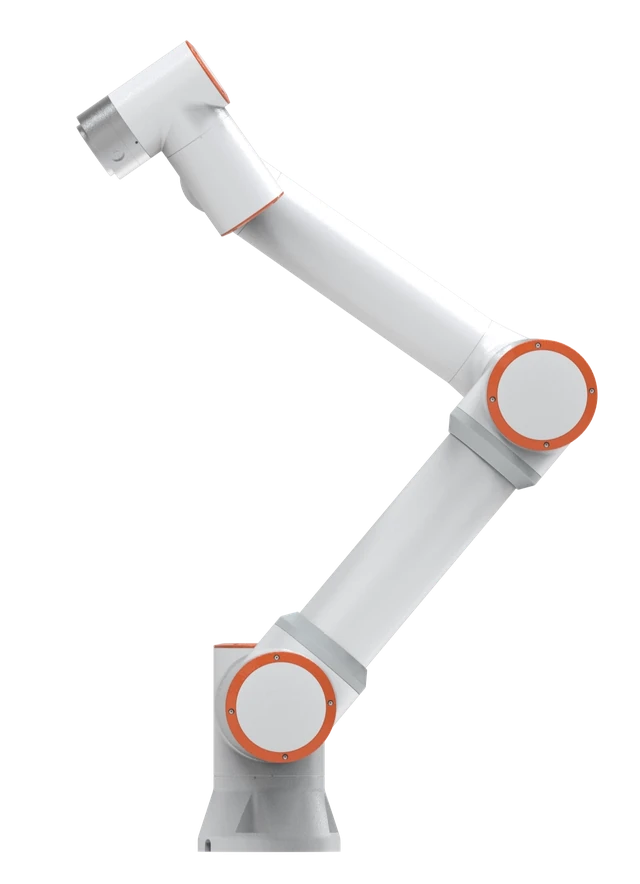
One configuration to evaluate for the requirements discussed here. Check tooling load, the complete motion path and process requirements before selecting the arm.
View FR5 specifications and quote considerationsA robot arm is usually the easiest line in the budget to price and rarely the largest. The working cell also needs tooling, a mount, a way to present parts, safeguarding, engineering hours and trained people. A lower arm price can leave more of a fixed budget for the items that decide whether the cell runs. Compare equivalent configurations and complete project scope to find whether that saving remains after installation.
What a published arm price does and does not cover
As one dated benchmark, the FAIRINO US listing for the FR5 displayed $8,699.00 USD when checked on November 4, 2026. That is a third-party seller's list price. The displayed price alone does not establish which equipment, freight, duties or taxes are included. It is not a thecobot.co offer and it is not a cell price. Ask for the configuration in writing before using any list price in a budget.
The arm also has to be the right arm. A FAIRINO FR5 (5 kg, 922 mm), a FAIRINO FR10 (10 kg, 1,400 mm) and a FAIRINO FR20 (20 kg, 1,854 mm) sit at different price points, and payload must cover the gripper, adapter and cables as well as the part.
A quotation scope table for comparing bids
Send this table to every bidder and ask them to mark each line included, excluded, optional or customer-supplied, with a price or allowance. Two quotes can only be compared once the same lines are filled in.
| Budget line | What to pin down | What moves the cost |
|---|---|---|
| 1. Arm and controller | Exact model, control box, pendant, cables, software options, freight | Payload and reach class; protection rating; options |
| 2. End-of-arm tooling | Gripper or process tool, fingers, adapter plate, valves, tool-side cabling | Number of part families; custom fingers; tool changing |
| 3. Mounting | Pedestal, table or cart, anchoring, levelling, floor condition | Fixed versus movable cell; reach from the chosen position |
| 4. Part presentation and fixtures | Trays, drawers, conveyors, nests, clamps, outfeed | Part variety and how long the cell must run unattended |
| 5. Sensing and vision | Part-present sensors, camera, lighting, software licence, calibration | Whether parts arrive located or loose |
| 6. Safeguarding and risk assessment | Documented assessment, scanners or guarding, safety wiring, validation | Tool and part hazards; speeds; who enters the space |
| 7. Integration and programming | Machine or PLC handshake, electrical work, programs, recovery routines, trials | Number of interfaces and part programs; acceptance criteria |
| 8. Training and documentation | Operator and maintainer training, drawings, backups, source programs | How much your team will edit after handover |
| 9. Spares and ongoing costs | Wear parts, spare tooling, support terms, software charges, utilities | Shifts run; consumable tooling; remote or on-site support |
Safeguarding. OSHA's technical manual chapter on robot systems puts the duty on the integrator to see that a risk assessment is completed and documented before commissioning, and tells employers to obtain it. A collaborative arm does not remove that step: the gripper, the part and the surrounding equipment are part of the assessed application. If you integrate the cell yourself, that work and cost move to you. Our guide to what a cobot risk assessment covers lists what the document should contain.
Tooling and part presentation. These lines are specific to your parts, so they are where a generic package price stops being useful. Define the tool with the end-effector selection guide before pricing it. If the parts cannot be presented in a known position, the vision line appears, and it has its own hidden scope; see how to compare 3D camera quotes.
Integration labour. Hours depend on interfaces and on how many part programs must be proven. Ask for the hourly basis, the number of programs included and the price of each additional one.
A hypothetical worked budget
The figures below are invented round numbers to show proportions. They are not FAIRINO prices, thecobot.co prices or market averages. Assumptions: one small cobot tending one machine, two part families, parts presented in trays without vision, a single machine interface, and an integrator supplying the complete cell.
| Line | Hypothetical amount | Share of total |
|---|---|---|
| Arm and controller | $10,000 | 17% |
| End-of-arm tooling | $5,000 | 8% |
| Mounting | $3,000 | 5% |
| Part presentation and fixtures | $8,000 | 13% |
| Sensing (no vision) | $4,000 | 7% |
| Safeguarding and risk assessment | $6,000 | 10% |
| Integration and programming | $16,000 | 27% |
| Training and documentation | $3,000 | 5% |
| Freight, installation and contingency | $5,000 | 8% |
| Total | $60,000 | 100% |
Now change one input. If the arm line were $25,000 with everything else equal, the total becomes $75,000 and the arm's share rises from 17% to 33%. The $15,000 difference is close to the whole integration line in this example. That arithmetic only holds if the lower-priced arm needs no extra tooling, engineering or support to do the same job, which is exactly what line-by-line quotes reveal.
Costs that arrive after acceptance
NIST's Manufacturing Extension Partnership makes several points in its Automation 101 planning guide that belong in the budget. A first automation project almost always costs more, and takes longer, than later ones, because skills such as programming are being built for the first time. Maintenance capability and added cybersecurity are described as costs of doing business. Many companies plan for 12 to 18 months to reach full production. The same guide reports one Wisconsin manufacturer that spent $7,500 on a feasibility study before a $107,000 custom cobot welding cell; that is a single published case in US dollars, useful mainly as a reminder that study and cell are separate lines.
Budget for the ramp as well: operator time during trials, scrap while the process is tuned and spare gripper fingers. These belong in the payback model in our automation business-case guide.
On US tax treatment, the IRS describes a Section 179 election and a special depreciation allowance for qualifying property in Topic 704 on depreciation, each with limits and conditions. Whether your arm, tooling and installation labour qualify, and in which year, is a question for your accountant.
Turn the table into an application budget
Price a suitable standard arm alongside the fixtures, safeguarding, and engineering hours the application needs. Check whether a lower hardware price changes the total delivered cost or shifts work into integration. Another robot type may fit better when the task needs higher speed, heavier payload or a process package a supplier already sells complete. Use the project planner to record parts, cycle and layout, compare bidders with the vendor-selection guide, then discuss your automation project with the scope table filled in as far as you can.
Sources and further reading
Plan your next automation project
Share your parts, process, and production goals. Get help comparing robot options, planning the complete application, and deciding what to do next.
Request a consultation