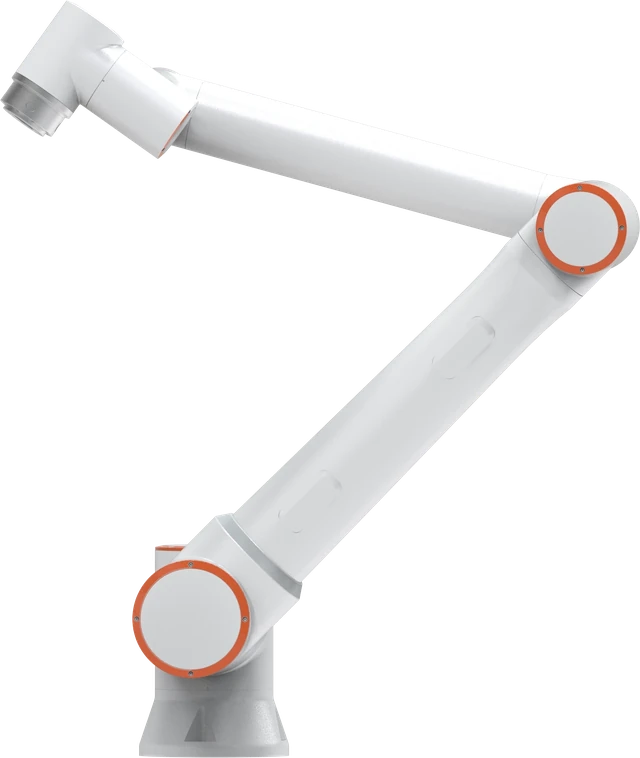
One configuration to evaluate for the requirements discussed here. Check tooling load, the complete motion path and process requirements before selecting the arm.
View FR10 specifications and quote considerationsPick the gripper arrangement first, then the arm. A machine tending robot carries the part, one or two grippers, fingers and a mounting plate, and it has to deliver all of that through a door opening to the chuck or vise. The FAIRINO catalog examples below compare the FR5, FR10, FR16 and FR20 for different load and reach requirements. A standard model belongs on the shortlist only when it clears the complete load and access checks below with suitable margin.
Decide between one gripper and two
A single gripper makes two trips into the machine: one to remove the finished part and one to load the blank. A dual arrangement carries the blank in, takes the finished part out with the second gripper, rotates and loads, so the door is open for one visit. The OnRobot Dual Quick Changer page describes the same one-cycle exchange.
On a long cut the second trip costs little, and a single gripper is lighter and easier to get past the door frame. On short cycles, or when raw and finished shapes need different fingers, two grippers earn their weight. For steel blanks that jaws cannot reach, a magnetic gripper is a third arrangement to test. Valuing the recovered seconds is covered in the machine tending business case guide.
Tally everything the wrist carries
With two grippers there is a moment when the arm holds the blank and the finished part together. The Haas Cobot Package operation manual states the rule plainly: the net gripper mass plus both the raw and finished part masses must come to less than the robot's maximum payload.
The tally below is illustrative. Its masses are invented, except the 0.41 kg dual plate, a published figure from the OnRobot page above.
| Carried item | Single gripper | Dual gripper |
|---|---|---|
| Raw blank | 3.0 kg | 3.0 kg |
| Finished part held at the swap | 0 kg | 2.4 kg |
| Gripper bodies (assumed 1.0 kg each) | 1.0 kg | 2.0 kg |
| Custom fingers (assumed 0.3 kg per set) | 0.3 kg | 0.6 kg |
| Mounting or dual plate | 0.2 kg (assumed) | 0.41 kg |
| Air-blast nozzle, valves, hoses (assumed) | 0.3 kg | 0.3 kg |
| Total at the wrist | 4.8 kg | 8.71 kg |
The same 3 kg blank sits at the edge of a 5 kg arm with one gripper and needs a 10 kg class arm with two. A dual head holds each part off the flange centre, so have the supplier check centre of mass and moment against the manufacturer's limits for the quoted model. The payload and reach checklist lists what to send.
Measure reach through the door, not across the floor
Catalog reach is a radius from the base. The useful question is whether the wrist, with the gripper oriented correctly, can get to the workholding and back out. Three points decide it: the deepest load position inside the machine, the farthest infeed pocket and the outfeed drop. A base close enough to reach the spindle may be too close for the elbow to fold through the opening, so check the whole path.
Lathes
The part goes in along the spindle centreline and must seat against the jaws, so a dual head needs swing room between chuck, turret and door. The Haas manual adds a caution for keyed or asymmetric parts: lathes without a C-axis or spindle home switch cannot guarantee a repeatable spindle orientation, so verify it at setup.
Mills
Loading is usually from above into a vise or fixture, so the arm needs height under the spindle head. Chips on locating surfaces are a common cause of a badly seated part; allow for an air-blast step. If parts arrive in trays, the tray loading guide covers the pick side.
A conditional FAIRINO shortlist
Payload and reach are catalog values for the standard models. They narrow the list without validating a cell.
| Model | Catalog payload | Catalog reach | Consider it when |
|---|---|---|---|
| FR5 | 5 kg | 922 mm | Small parts, one light gripper, base close to the machine |
| FR10 | 10 kg | 1,400 mm | Dual gripper on small parts, or a longer path to the table |
| FR16 | 16 kg | 1,034 mm | Heavier blanks or dual head, base close to the opening |
| FR20 | 20 kg | 1,854 mm | Heavy parts and long reach together |
The FR16 carries more than the FR10 but reaches less. If the tally says 12 kg and the layout needs 1,300 mm, neither fits and the FR20 becomes the candidate. When parts plus tooling exceed these figures, a larger industrial robot or gantry loader is the better answer.
Coolant, chips and what the IP note settles
The catalog lists these arms as IP54; IP65 optional. In the IEC 60529 code the first digit covers solid objects and the second liquid. A Siemens technical bulletin on enclosure ratings describes the liquid levels in terms of water: 4 is light spray from all directions and 5 is light water jets. It lists a separate UL Type 13 category for spraying water and oil.
So the note describes dust and water protection. It does not say how seals and cable jackets tolerate your coolant or cutting oil over time, whether the IP65 option is the one in your quote, or what the controller, pendant, gripper and connectors are rated. Grippers carry their own figures; Robotiq lists IP67 for the Hand-E gripper, for example. Ask in writing about coolant compatibility.
Machine signals to name in the request
In outline, the robot and CNC exchange:
- Door: open and close commands for an automatic door, with confirmed states.
- Workholding: clamp and unclamp for the chuck or vise, with confirmation where available.
- Cycle start: issued only after the robot is clear of the enclosure.
- Machine status: ready, in cycle, cycle complete and alarm.
- Robot status: ready, fault and part present.
- Safety: how emergency stops and protective devices on each side affect the other.
The method depends on the machine. Haas runs gripper, workholding and air-blast states from its own control. Robotiq's kit instead reads the machine's signal light and presses cycle start with an actuator. Ask the machine builder what interface your control already has. The cell layout checklist assigns each interface to an owner.
A collaborative arm does not make the cell safe by itself: the Haas manual lists a fence interlock, area scanner or light curtain as safety devices for its cobot packages. Your measures come from the cell's risk assessment; see what a cobot risk assessment must cover.
Send the heaviest part, gripper plan, door dimensions and control model to narrow the list. Discuss your automation project or see the machine tending overview.
Sources and further reading
Plan your next automation project
Share your parts, process, and production goals. Get help comparing robot options, planning the complete application, and deciding what to do next.
Request a consultation